
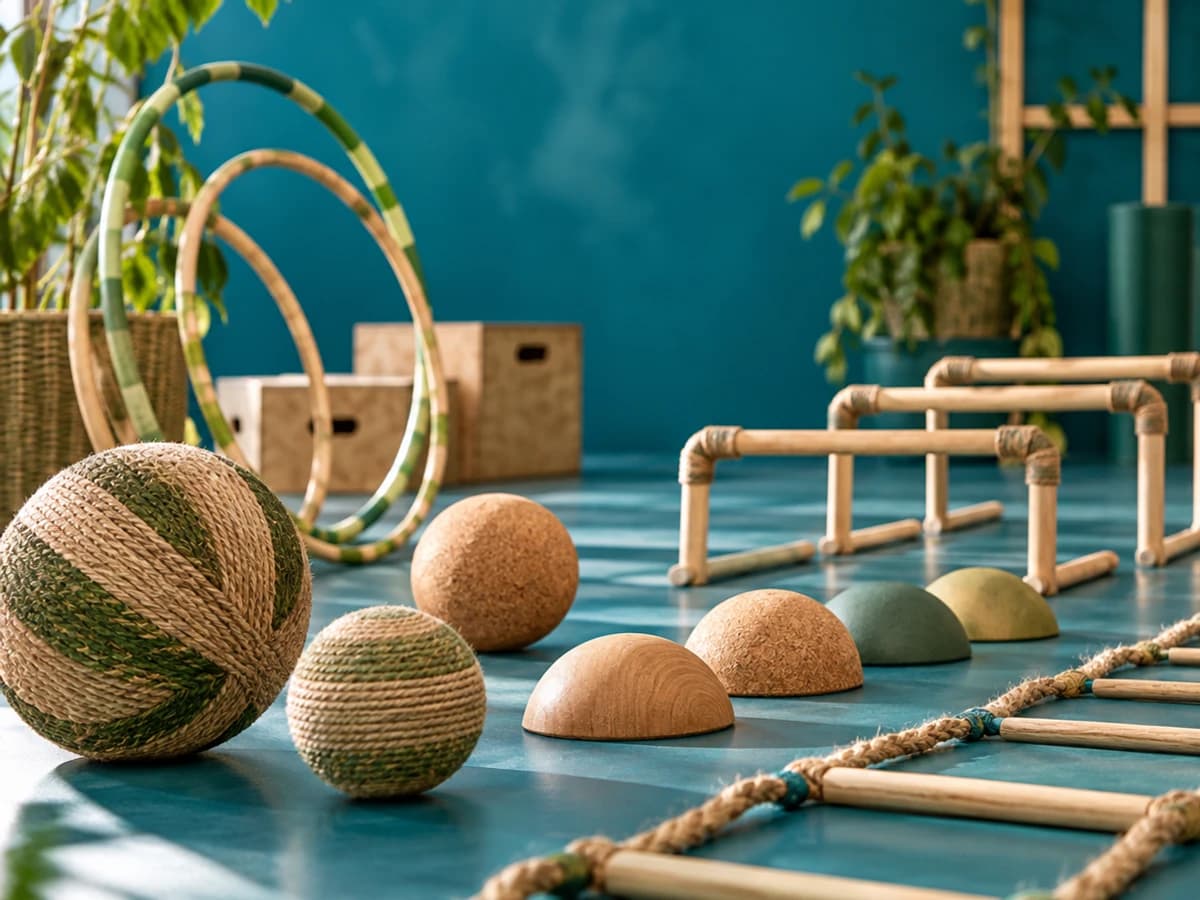
Sustainable sports games for improving coordination - eco-friendly alternatives 2026 | Sustainable sports games for improving coordination 2026 combine motor-skill training with eco-conscious design, replacing single-use plastics with recycled, durable materials. In Germany, where sporting goods demand is shifting toward sustainability, families, schools, clubs, and therapy practices seek coordination tools that are both effective and environmentally responsible. Equipment built from recycled ocean plastic, designed for intuitive, hand-eye coordination play, works for every generation in the same session.
<blockquote>Coordination is a skill we practice our whole lives, but the equipment we use to train it has rarely matched the sustainability of the movement itself. That gap is finally closing in 2026.</blockquote>

<hr>

<h2>What Makes a Sports Game "Sustainable" for Coordination Training?</h2>

<p>A sustainable sports game is built from recycled or renewable materials, engineered for multi-year durability, and designed for multiple age groups without needing separate gear. Coordination training is most effective when repeated consistently over months, not abandoned when equipment wears out or ends up in landfill.</p>

<h3>Material Sourcing</h3>
<p>Traditional racket sports rely on virgin plastics difficult to recycle at end of life. German environmental research shows that <strong>complex material composites in sports equipment make recycling significantly harder</strong>.</p>

<h3>Design Longevity</h3>
<p>Products engineered for repeated use <strong>reduce the churn of cheap gear that dominates big-box sporting goods</strong>.</p>

<ul>
    <li><strong>Recycled base material:</strong> Equipment made from post-consumer or ocean-bound plastic instead of virgin polymer reduces reliance on new petroleum-based inputs.</li>
    <li><strong>Single-product versatility:</strong> A tool usable indoors, outdoors, solo, or in groups cuts down on the number of separate products needed.</li>
    <li><strong>Certified supply chains:</strong> Look for traceable sourcing, similar to standards like the <a target="_blank" rel="nofollow noopener noreferrer" href="https://www.global-standard.org/">Global Recycled Standard (GRS)</a>, which verify recycled content claims.</li>
    <li><strong>Repairability:</strong> Durable components that can be replaced individually extend a product's working life.</li>
</ul>

<p><strong>Key Takeaway:</strong> Sustainable coordination equipment is defined by verifiable material sourcing, multi-use design, and build quality intended to last years rather than one season. For deeper context, see <a href="https://sportsfornature.org/news/sports-for-nature-initiative-shaping-focus-on-biodiversity-in-sports-and-the-olympic-movement/" target="_blank" rel="nofollow noopener noreferrer" style="color: #0864c7; text-decoration: none; font-weight: 400;">Sports for Nature initiative shaping focus on biodiversity in ...</a>.</p>

<hr>

<h2>Why Coordination Training Matters for Every Age Group in Germany</h2>

<p>Coordination training builds neural and motor pathways supporting balance, reaction speed, and spatial awareness across all ages. <strong>German health data shows this touches children, working adults, and seniors</strong> in different but overlapping ways.</p>

<h3>The Youth Movement Gap</h3>
<p>The long-running <a target="_blank" rel="nofollow noopener noreferrer" href="https://www.ifss.kit.edu/MoMo/downloads/SPIEGEL%20ONLINE.pdf">MoMo study from the Karlsruhe Institute of Technology</a> found <strong>physical activity among 4- to 17-year-olds fell 37 percent over twelve years</strong>. Data from the KiGGS Wave 2 study shows roughly a quarter of 3- to 17-year-olds in Germany do not meet WHO recommendations for daily physical activity.</p>

<h3>Official Movement Recommendations</h3>
<p>German guidance exceeds WHO baselines. As outlined at the <a target="_blank" rel="nofollow noopener noreferrer" href="https://www.ifss.kit.edu/kongress25/downloads/Kongress-Brosch%c3%bcre_Kinder%20bewegen.pdf">Kinder bewegen congress at KIT</a>, the WHO recommends 60 minutes of daily activity for children, while <strong>German recommendations advise 90 minutes daily</strong>.</p>

<table>
    <thead>
        <tr>
            <th>Age Group</th>
            <th>Primary Coordination Benefit</th>
            <th>Relevant Concern in Germany</th>
        </tr>
    </thead>
    <tbody>
        <tr>
            <td>Children (3-12)</td>
            <td>Hand-eye coordination, balance, motor planning</td>
            <td>Rising sedentary screen time in schools</td>
        </tr>
        <tr>
            <td>Teens and young adults</td>
            <td>Reaction time, spatial awareness</td>
            <td>Declining club participation after age 14</td>
        </tr>
        <tr>
            <td>Fitness enthusiasts</td>
            <td>Neuromuscular efficiency, agility</td>
            <td>Demand for low-impact cross-training</td>
        </tr>
        <tr>
            <td>Seniors</td>
            <td>Fall prevention, balance retention</td>
            <td>Aging population, mobility independence</td>
        </tr>
        <tr>
            <td>Rehab and therapy clients</td>
            <td>Fine motor recovery, bilateral coordination</td>
            <td>Post-injury or neurological rehabilitation</td>
        </tr>
    </tbody>
</table>

<p><strong>Key Takeaway:</strong> Coordination decline spans childhood motor development, adult fitness, and senior fall prevention, making multi-generational tools genuinely valuable at household and institutional levels.</p>

<hr>

<h2>Eco-Friendly Sports Equipment: Materials and Standards to Look For</h2>

<p>Eco-friendly sports equipment in 2026 relies on recycled polyester, ocean-bound plastic, or certified bio-based fibers instead of virgin plastics. <strong>German consumers increasingly expect manufacturers to prove it</strong>. Market researchers report 70% of consumers prefer sustainable sports equipment, pushing brands to rethink sourcing across product lines.</p>

<h3>The Regulatory Backdrop</h3>
<p>Germany's packaging rules shape procurement decisions for clubs, schools, and retailers. The <strong>German Packaging Act (Verpackungsgesetz)</strong> mandates manufacturers register packaging, ensure recyclability, and meet recycling quotas, as detailed by <a target="_blank" rel="nofollow noopener noreferrer" href="https://www.kenresearch.com/germany-sports-equipment-and-outdoor-gear-market">market researchers tracking the German sports sector</a>.</p>

<h3>Common Material Pitfalls</h3>
<p>Not every "green" label holds up. As <a target="_blank" rel="nofollow noopener noreferrer" href="https://www.tuev-nord.de/de/wissen/explore/nachhaltig-sporteln/">TÜV Nord points out</a>, recycled PET bottles for backpacks do not make products biodegradable, and <strong>microplastic shedding remains a persistent issue</strong>.</p>

<table>
    <thead>
        <tr>
            <th>Material Type</th>
            <th>Source</th>
            <th>Typical Use</th>
            <th>Sustainability Consideration</th>
        </tr>
    </thead>
    <tbody>
        <tr>
            <td>Virgin plastic composites</td>
            <td>Petroleum-based</td>
            <td>Low-cost rackets, balls</td>
            <td>High carbon footprint, rarely recyclable</td>
        </tr>
        <tr>
            <td>Recycled PET (rPET)</td>
            <td>Land-based plastic bottles</td>
            <td>Apparel, bags, some hard goods</td>
            <td>Reduces virgin plastic demand, still sheds microplastic</td>
        </tr>
        <tr>
            <td>Ocean-bound recycled plastic</td>
            <td>Coastal cleanup, pre-ocean waste</td>
            <td>Injection-molded hard goods (paddles, tools)</td>
            <td>Diverts waste before it reaches open water</td>
        </tr>
        <tr>
            <td>Bio-based natural fibers</td>
            <td>Hemp, organic cotton, wood fiber</td>
            <td>Apparel, grips</td>
            <td>Compostable but less durable for hard-impact gear</td>
        </tr>
    </tbody>
</table>

<ul>
    <li><strong>Verified recycled content:</strong> Confirm the percentage of post-consumer or ocean-bound material, not just generic "eco" claims.</li>
    <li><strong>Swiss and German manufacturing transparency:</strong> Shorter supply chains reduce shipping emissions and make sourcing claims easier to audit.</li>
    <li><strong>Certification references:</strong> Standards bodies like those developed with the <a target="_blank" rel="nofollow noopener noreferrer" href="https://www.tide.earth/en/">Institute for Materials Technology and Plastics Processing (IWK)</a> in Switzerland add scientific credibility.</li>
    <li><strong>Durability over disposability:</strong> A well-built product lasting five years outperforms three cheaper versions discarded in the same period.</li>
</ul>

<p><strong>Key Takeaway:</strong> Look past generic "eco-friendly" labeling and ask specifically what percentage of a product is recycled, where that material originated, and whether manufacturing has been independently developed with a materials science partner. For deeper context, see <a href="https://climatesort.com/eco-friendly-sport/" target="_blank" rel="nofollow noopener noreferrer" style="color: #0864c7; text-decoration: none; font-weight: 400;">5 Eco-Friendly Sports and 5 That Harm the Environment</a>.</p>

<hr>

<h2>Sustainable Sports Games for Improving Coordination - Eco-Friendly Alternatives 2026: The Smaggxx Approach</h2>

<p>Among sustainable coordination games, those built on ocean-recovered plastic show how sustainability and performance coexist. <a href="https://www.smaggxx.ch" target="_blank">Smaggxx</a> is a Swiss-made ball game played with two Splates®, one in each hand, designed to improve coordination, reaction time, balance, focus, and cognitive skills.</p>

<h3>Material Story: Ocean Plastic, Not Just Recycled Plastic</h3>
<p>The Splates® are made in Switzerland from <strong>#tide ocean material®</strong>, recycled from ocean-bound plastic. More than eight million tons of plastic trash land in oceans and coastlines yearly. The material has been developed and tested with the Institute for Materials Technology and Plastics Processing (IWK) at the University of Applied Sciences in Rapperswil, Switzerland, giving Smaggxx a scientifically verified sustainability story rather than loose marketing.</p>

<h3>Why the Two-Handed Format Builds Coordination Faster</h3>
<p>Playing with a Splate® in each hand forces <strong>bilateral coordination</strong>, the cross-body motor pattern therapists use to train reaction time and cognitive-motor integration simultaneously. This design delivers immediate success even for first-time players, keeping engagement high enough for coordination gains to compound over repeated sessions.</p>

<table>
    <thead>
        <tr>
            <th>Feature</th>
            <th>Traditional Racket/Paddle Sport</th>
            <th>Smaggxx Approach</th>
        </tr>
    </thead>
    <tbody>
        <tr>
            <td>Core material</td>
            <td>Virgin plastic, composite laminates</td>
            <td>Recycled #tide ocean material®</td>
        </tr>
        <tr>
            <td>Manufacturing origin</td>
            <td>Often imported, longer supply chains</td>
            <td>Made in Switzerland</td>
        </tr>
        <tr>
            <td>Coordination mechanics</td>
            <td>Single-hand racket control</td>
            <td>Two-hand bilateral Splate® control for neuro-training</td>
        </tr>
        <tr>
            <td>Playing surface flexibility</td>
            <td>Court-specific in many cases</td>
            <td>Indoors, outdoors, on tennis and pickleball courts</td>
        </tr>
        <tr>
            <td>Generational accessibility</td>
            <td>Skill threshold varies by sport</td>
            <td>Intuitive for children, adults, and seniors alike</td>
        </tr>
    </tbody>
</table>

<blockquote>Giving plastic waste pulled from coastlines a second life as a Swiss-made coordination tool is the kind of circular story that turns a sports product into a genuine sustainability statement.</blockquote>

<ul>
    <li><strong>Swiss-made craftsmanship:</strong> Production supports shorter, more transparent supply chains and consistent build quality.</li>
    <li><strong>Inclusive multi-generational play:</strong> The same set works for a child's first coordination session and a grandparent's balance routine.</li>
    <li><strong>Social and solo flexibility:</strong> Smaggxx plays alone, in pairs, or in groups, adapting to family afternoons, club sessions, or therapy practice.</li>
    <li><strong>Ocean plastic sourcing:</strong> Splates® rely on recycled ocean-bound material rather than newly manufactured plastic.</li>
</ul>

<p><strong>Key Takeaway:</strong> Smaggxx combines a scientifically credible recycled-ocean-plastic supply chain with an intuitive, two-handed training format that bridges age groups rather than isolating them. For deeper context, see <a href="https://www.sportanddev.org/latest/events/change-game-sport-conference" target="_blank" rel="nofollow noopener noreferrer" style="color: #0864c7; text-decoration: none; font-weight: 400;">Change the Game Sport Conference</a>.</p>
Discover SMAGGXX®, the Swiss-made two-handed ball game and training tool for focus, coordination and fun.
Shop SMAGGXX®<h2>Bringing Sustainable Coordination Games Into Schools, Clubs and Rehab Settings</h2>
<p>Integrating sustainable coordination games works best when equipment requires minimal setup, suits mixed-ability groups, and withstands daily institutional use. With roughly <strong>5,500 local sports clubs forming the backbone of community activity in Germany</strong>, equipment choices made at club level ripple out to thousands of participants.</p>
<h3>For Schools and Youth Programs</h3>
<p>PE teachers managing large, mixed-skill classes benefit from games producing quick wins for beginners while challenging advanced students. A <strong>two-handed coordination format reduces the frustration curve</strong> that discourages less athletic children.</p>
<h3>For Rehabilitation and Senior Fitness</h3>
<p>Therapy professionals working on bilateral motor recovery or fall-prevention need tools that are low-impact, adjustable in intensity, and <strong>engaging enough that clients want to keep practicing between sessions</strong>.</p>
<ul>
<li><strong>Clubs and sports associations:</strong> Durable, recycled-material equipment reduces repeat procurement costs over multi-year membership cycles.</li>
<li><strong>Primary and secondary schools:</strong> Games playable indoors or outdoors keep PE programming flexible year-round.</li>
<li><strong>Rehabilitation clinics:</strong> Bilateral, low-impact coordination tools support neuro-motor recovery protocols without requiring full court setup.</li>
<li><strong>Senior centers and fitness studios:</strong> Lightweight, intuitive equipment supports balance and reaction-time training central to fall-prevention programming.</li>
<li><strong>Families:</strong> A single, durable set working for every generation reduces clutter of age-specific toys.</li>
</ul>
<p><strong>Key Takeaway:</strong> The qualities making a product sustainable-durability, versatility, and intuitive design-are exactly what institutional buyers need to justify long-term investment in coordination equipment.</p>
<hr>
<h2>Conclusion</h2>
<p><strong>Sustainable sports games for improving coordination 2026</strong> represent a genuine upgrade in both durability and inclusivity. Germany's eco-conscious consumer base, paired with documented coordination gaps across age groups, makes this an ideal moment for families, schools, clubs, and therapy practices to rethink equipment choices.</p>
<ul>
<li><strong>Material matters:</strong> Prioritize recycled or ocean-bound plastic over virgin polymer composites.</li>
<li><strong>Coordination is lifelong:</strong> Bilateral coordination training benefits nearly every age group from childhood to senior years.</li>
<li><strong>Versatility reduces waste:</strong> One multi-use, multi-generational tool outperforms several single-purpose products on cost and environmental impact.</li>
<li><strong>Transparency builds trust:</strong> Look for verifiable sourcing partnerships like #tide ocean material® rather than vague sustainability claims.</li>
<li><strong>Swiss-made quality:</strong> Shorter, traceable supply chains support both environmental and quality goals.</li>
</ul>
<p>Exploring options like Smaggxx is a practical next step for anyone ready to pair coordination training with a genuinely sustainable, Swiss-made product built from recycled ocean plastic.</p>
<hr>
<h2>FAQ</h2>
<h3>What are the best sustainable sports games for improving coordination in 2026?</h3>
<p>The strongest options combine recycled or ocean-bound plastic materials with designs training bilateral coordination, reaction time, and balance across multiple age groups. Products like Smaggxx, made from recycled #tide ocean material® in Switzerland, pair verified sustainable sourcing with a two-handed Splate® format that works for children, adults, and seniors alike.</p>
<h3>Why is coordination training important for children in Germany?</h3>
<p>Coordination training supports motor development when German data shows declining activity levels among youth. Research from the KiGGS Wave 2 study found roughly a quarter of 3- to 17-year-olds in Germany do not meet WHO daily movement recommendations, making <strong>accessible, engaging coordination games important for reversing that trend</strong>.</p>
<h3>What makes a sports product genuinely eco-friendly versus just "greenwashed"?</h3>
<p>A genuinely eco-friendly product discloses verified percentages and sources of recycled material, is manufactured under traceable supply-chain conditions, and is built for multi-year durability. <strong>Vague labels without material percentages or sourcing documentation should be treated with skepticism</strong>.</p>
<h3>Can coordination games made from recycled ocean plastic match the performance of traditional equipment?</h3>
<p>Yes. Materials like #tide ocean material® are developed and tested with materials science institutions, including the Institute for Materials Technology and Plastics Processing (IWK) in Switzerland, meaning <strong>performance and durability are engineered to match or exceed conventional plastic equivalents</strong>.</p>
<h3>Are coordination games suitable for seniors and rehabilitation patients?</h3>
<p>Yes. Low-impact, bilateral coordination activities are widely used in fall-prevention and motor-recovery programming because they train balance, reaction time, and fine motor control without high joint stress.</p>
<h3>How many hours of physical activity do German health guidelines recommend for children?</h3>
<p>German recommendations exceed WHO standards. According to materials from the Kinder bewegen congress at KIT, while the WHO recommends 60 minutes of daily activity, <strong>German recommendations advise 90 minutes daily for children and adolescents</strong>.</p>
<h3>Where can I buy sustainable coordination equipment made from recycled ocean plastic in Switzerland or Germany?</h3>
<p>Swiss-made products such as Smaggxx are available for individuals, families, clubs, teams, and businesses, offering Splates® crafted from recycled #tide ocean material® alongside instructions suited for indoor, outdoor, solo, or group play.</p>
<p><em>This article was compiled using publicly available German and Swiss market research, health monitoring publications, and manufacturer-disclosed material sourcing information current as of October 2026.</em></p>