
Updated Oct 18, 2026
Companies asking, "Is Spikeball suitable for corporate events and team building? Experiences 2026" tend to get a nuanced answer. Spikeball works for small, casual office gatherings, but it hits serious structural limits at larger corporate events. The core format caps active play at four participants per net (two against two), needs a flat outdoor space, and leaves most of a bigger group watching from the sidelines. That gap is what Smaggxx was designed to fill.
This article looks at where Spikeball fits, where it falls short for German corporate events in 2026, and what HR managers, event agencies, and team leads should weigh when planning corporate event ideas 2026 that involve everyone on the guest list.
A game that only four people can play at once was never designed to carry the weight of a 150-person company summer party.
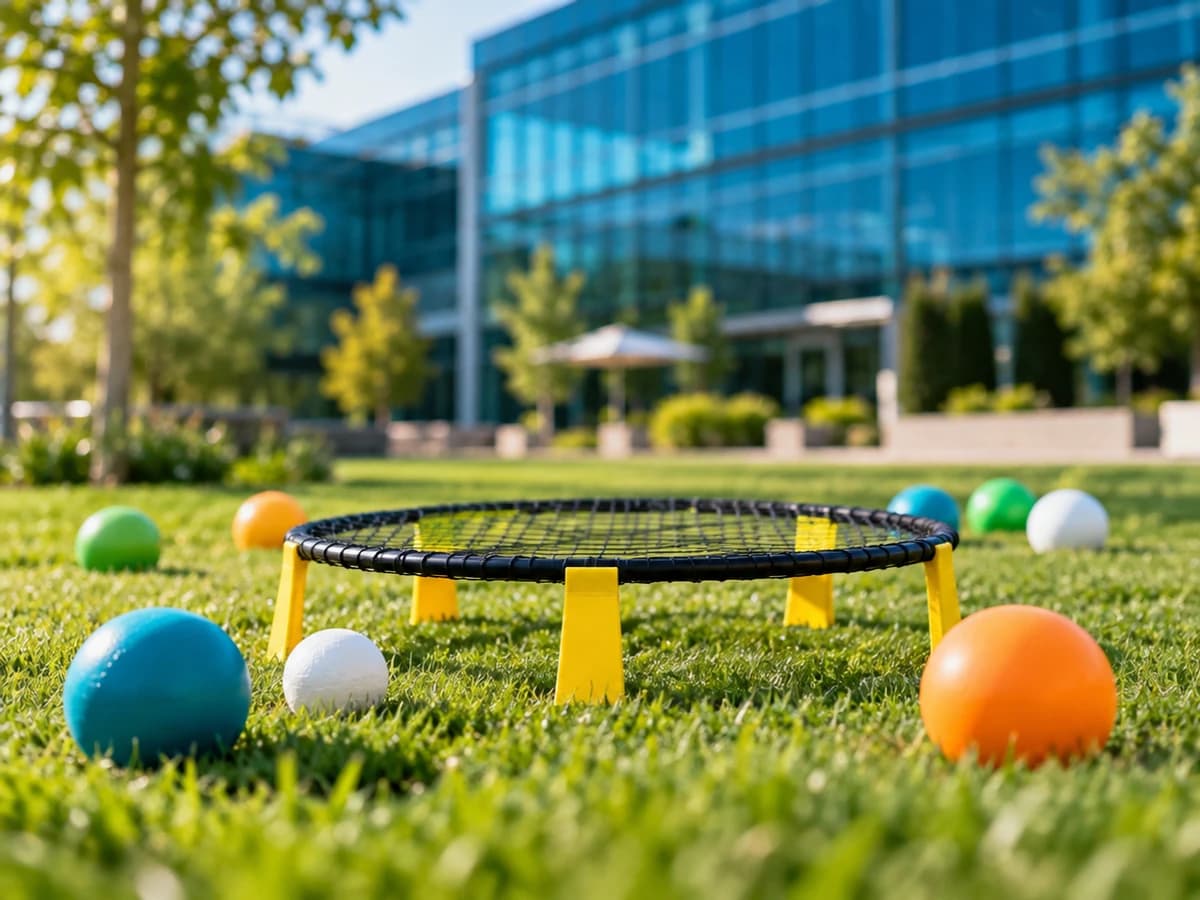
Spikeball is a roundnet game in which two teams of two hit a ball off a small trampoline-style net. It suits small, informal corporate breaks, but it struggles as the main activity in a larger team-building program. Roundnet, the sport behind the Spikeball brand, was created in 1989 and is played between two teams, usually with two players each, and that basic structure already hints at its ceiling for group events.
German event planners in 2026 usually describe Spikeball as a fun "fifth activity station" at a summer festival rather than the centerpiece of a corporate event. It photographs well and takes under a minute to explain. It also suits a relaxed Friday afternoon office garden session. But only a few people ever get a turn.
Key Takeaway: Spikeball in 2026 is a pleasant niche activity for small, able-bodied, outdoor groups. It was never engineered as a scalable team-building game for companies with large, diverse workforces. For deeper context, see Spikeball.
The biggest constraint for corporate use is participation capacity. Official rules cap each round at two teams of two, so only four people touch the ball at once. That matters when an HR manager is trying to activate 60, 150, or 400 employees at the same time.
Several official rule sets used in recreational leagues confirm that each team should consist of a minimum of two (2) players and no more than 4 players, with each team only allowed 2 players on the field playing at once. That means at most four active players and perhaps two to four substitutes waiting per net. For a full department outing, that creates a serious bottleneck, and nobody enjoys queuing for forty minutes to get three rallies in.
Spikeball is officially classified as an indoor or outdoor, net and wall game, but in practice it needs a flat, obstacle-free surface and room around the net for diving. German corporate events held from October through March, when outdoor temperatures often hover near freezing, cannot rely on it as a primary format.
| Constraint | Spikeball Reality | Impact on a 2026 Corporate Event |
|---|---|---|
| Active players per net | Maximum 4 (2 vs. 2) | Long rotation queues for groups over 20 people |
| Venue requirement | Flat outdoor or open indoor space with diving room | Unsuitable for hotel conference rooms, office floors, trade-fair booths |
| Weather dependency | Best in dry, warm conditions | Limits use to spring and summer events in Germany |
| Physical accessibility | Diving, lunging, fast lateral movement | Excludes seniors, less mobile staff, and mixed-ability teams |
| Learning curve for spectators | Fast, low-visibility rallies | Harder for non-players to stay engaged while waiting |
A format that benches most of the room is a networking problem disguised as a sport.
Key Takeaway: The four-player cap and outdoor-only reliability that make Spikeball charming at a backyard barbecue are exactly what make it a poor fit for scalable German corporate events, where inclusivity and weather flexibility matter. For deeper context, see Spikeball Vs Spikeball Pro Difference.
German HR managers in 2026 want team-building formats that work for everyone, regardless of age, fitness, or athletic background. Recent coverage of German corporate event trends notes that especially in teams with diverse work models, generations, and expectations, the company event becomes a valuable meeting point again. Cross-generational inclusivity is now a core planning criterion.
German event trend reports for 2026 reinforce this shift. One recent overview found that employees do not just want to watch, but to be part of the action themselves. Spectator-heavy formats will struggle to meet that expectation.
Key Takeaway: Modern German corporate event ideas for 2026 favor inclusive, low-barrier, weather-flexible games over niche sports with hard participation caps. For deeper context, see Team Building Activities: Ideas for Shift Teams (2026).
Smaggxx is a Swiss-made paddle-and-ball game played with two Splates, one in each hand. It is designed for solo, pair, or group play, indoors and outdoors. Because it can be set up across several courts or mini-stations at once, dozens of employees can be active simultaneously instead of waiting in line for a single net.
Smaggxx centers on accessible, intuitive, two-handed play that delivers quick success and genuine joy, rather than rewarding only the fastest or most athletic players. That makes it a natural fit for diverse groups, including families, teachers, fitness enthusiasts, seniors, children, and rehabilitation professionals, who might otherwise be sidelined by more demanding team sports.
Move. Play. Connect. The simplest team-building formats are the ones where nobody has to sit out.
Key Takeaway: Where Spikeball limits active play to four per net, Smaggxx's multi-court, two-handed format makes physical activity, coordination, and fun accessible to everyone on the guest list. For deeper context, see Spikeball Vs Slammo: What's the Difference?.
Discover SMAGGXX®, the Swiss-made two-handed ball game and training tool for focus, coordination and fun.
Shop SMAGGXX®Planning a movement-based corporate event in 2026 starts with matching the activity's participation capacity to the real headcount. The strongest plans treat the game as one lively, high-rotation station rather than a bottleneck the whole group must funnel through.
| Event Size | Recommended Setup | Format | Primary Goal |
|---|---|---|---|
| Small team (8-15 people) | 2-3 Smaggxx station setups | Rotating pairs, friendly round-robin | Quick energizer during an offsite or retreat |
| Mid-size department (20-60 people) | 5-8 parallel station setups | Mixed-team tournament brackets | Cross-departmental mixing and networking |
| Company-wide summer party (100+ people) | Multiple activity zones alongside other stations | Open-play drop-in zone with leaderboard | Inclusive entertainment for all ages and abilities |
| Wellness or health day | Indoor or outdoor court setup | Coordination and reaction-time challenges | Cognitive and physical wellness messaging |
Key Takeaway: A 2026 corporate event plan built around Smaggxx's multi-station, indoor-outdoor flexibility addresses the scalability and inclusivity gaps that limit single-net games.
Spikeball remains a fun, low-cost option for a handful of colleagues on a sunny afternoon. But its hard four-player cap, outdoor-only reliability, and physically demanding style make it a weak foundation for scalable German corporate events and team building in 2026. Companies that need every employee engaged, whatever their age, fitness level, or the weather forecast, are better served by formats built for inclusion and flexibility.
HR managers evaluating corporate event ideas 2026 should pilot a small movement-based session before committing to a company-wide program. Exploring Smaggxx's offering is a practical next step for teams that want everyone, not just the athletic few, to be part of the action.
Spikeball works well for small, informal outdoor breaks with four to eight colleagues, but 2026 experiences from German event planners show it struggles to scale. Official rules limit active play to two teams of two per net. For departments, summer parties, or mixed-ability groups, HR managers increasingly look for formats like Smaggxx that let more people play at the same time.
The biggest limitations are its four-player active cap per net, its reliance on flat outdoor space and dry weather, and its physically demanding diving style. That style can exclude seniors, children, or employees with mobility restrictions.
Formats that scale well allow multiple simultaneous stations, need minimal instruction, and work indoors and outdoors. Multi-court, two-handed games like Smaggxx, quiz-style competitions, and rotating outdoor challenge stations are among the options German companies favor in 2026.
Yes, Smaggxx can serve as a scalable alternative or complement to Spikeball-style activities. It can be set up across multiple courts, played indoors or outdoors, and engages people of all ages and fitness levels. Its Swiss-made, sustainable Splates also offer an environmental talking point.
Spikeball's diving and lunging style can be physically demanding and may unintentionally exclude seniors or less athletic employees. Smaggxx's intuitive, two-handed format is designed to deliver quick success regardless of athletic background.
Standard roundnet play requires a flat, obstacle-free surface with enough room around the net for players to dive and move sideways. That generally rules out most office interiors, hotel ballrooms, and trade-fair booths.
Priorities should include a low barrier to entry, scalable participation, indoor-outdoor flexibility for unpredictable weather, and genuine appeal across generations and fitness levels. German event trend data from 2026 consistently points toward interactive, participation-driven formats.
Companies can visit smaggxx.ch to review the product, its Swiss-made Splates, and its approach to inclusive, sustainable, movement-based play for individuals, families, clubs, teams, and businesses.
This article was compiled using publicly available roundnet rule documentation, German corporate event trend reports published in 2026, and Smaggxx's publicly stated product information. Experiences and preferences for team building formats vary by company culture, venue, and group size, so readers are encouraged to pilot any activity with a small group before scaling it.